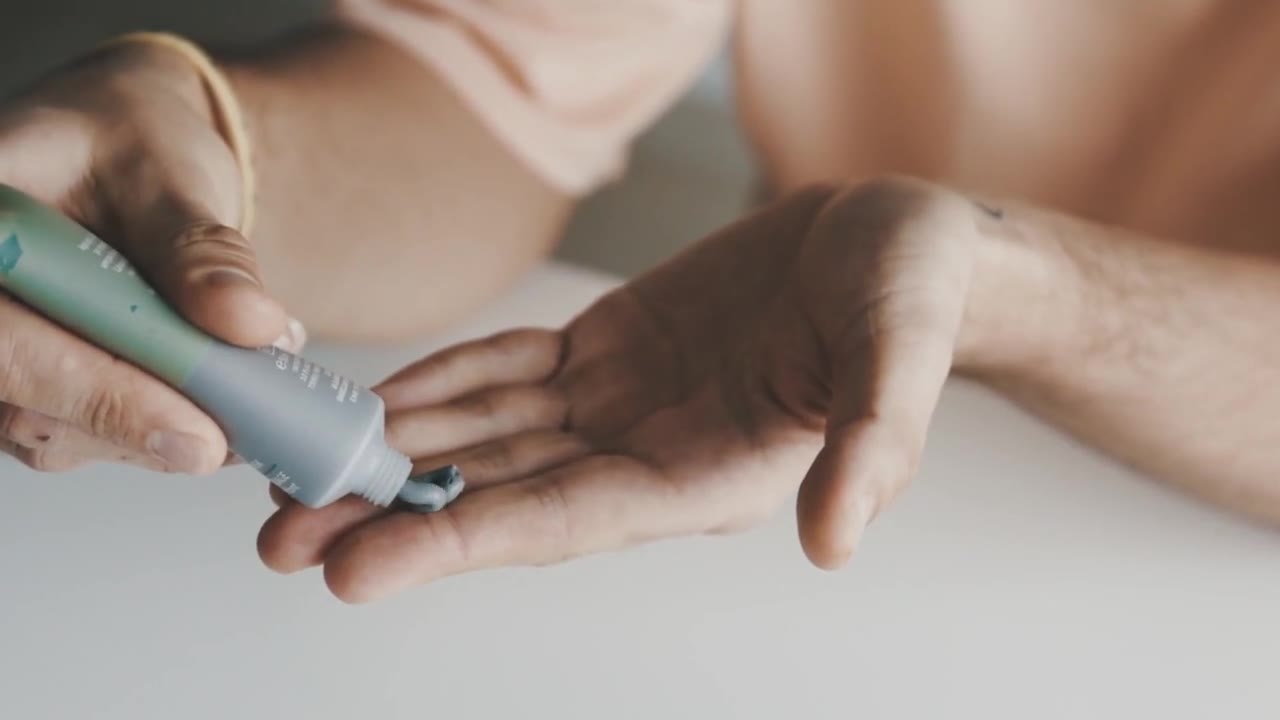
Cosmetics, water treatment and feed are three examples of how different components from crab shell processing can create new value. We are starting with cosmetics.
Application examples. Illustrative footage.
01 / Our first focus
Cosmetics
Chitosan can form a thin film, retain moisture and influence the consistency of a formulation. These properties make it interesting for skin care, hair care and styling. We are exploring how they can meet the needs of cosmetics manufacturers.
The right material type, purity and functionality must be established and tested in the intended formulation.
02 / A potential application
Water treatment
Chitosan can help small particles form larger flocs that are easier to separate from water. Its amino groups can also bind certain metal ions. This makes chitosan interesting for the development of treatment processes, adsorbents and filter materials.
Performance depends on water composition, pH and material properties, among other factors. This is a potential development direction, rather than a finished Havskall treatment solution.
03 / A potential application
Feed
Processing crab shells can separate the protein fraction for further processing into a protein hydrolysate. This could be relevant as an ingredient in fish feed and other animal feeds. We aim to explore how this side stream can be used to capture more of the value in the raw material.
Suitability, digestibility and nutritional value must be investigated for the intended species. Quality, safety and approval requirements must be established before use.
MORE POSSIBILITIES
Three examples. A wider world of possibilities.
Cosmetics, water treatment and feed are just three examples. Many more applications exist, including packaging, agriculture, coatings and biobased materials. A new idea often begins with a property that meets a specific need.
Chitin and chitosan are related biopolymers with different properties. Chitin has low solubility and provides natural structure. Chitosan is made by modifying part of the chitin structure, creating amino groups that can carry a positive charge in acidic solutions.
Films and gels
Chitosan can form films and be incorporated into gels. Think about a need for a thin coating, a surface or a particular consistency.
Binding and aggregation
Charge and chemical groups can enable interactions with particles, surfaces and certain dissolved substances, opening possibilities in separation and binding.
Structure and form
Chitin can provide structure. Chitin and chitosan can be processed into fibres, particles and membranes, depending on the method.
Biodegradability
Both can biodegrade under suitable conditions. The rate and extent depend on the material and its environment.
Properties are influenced by chain length, degree of deacetylation, purity and pH, among other factors. A material that works in one application will not automatically suit another. We aim to develop and characterise materials together with the people who will use them.
Do you need to bind something, build structure or create a functional surface? We would like to hear about the problem you want to solve, even if your application is not listed here.
We would like to hear from businesses looking for biobased ingredients and materials. Express your interest in future samples, product testing or development partnerships.
Products are in development. Expressing interest is nonbinding and does not place an order or guarantee supply.
FOLLOW OUR PROGRESS
News from Havskall.
Get updates on development, testing and new opportunities. We write when we have something to share.